Quick Answer
Your newborn sleeps 16-17 hours a day, feeds 8-12 times, and communicates almost entirely through crying — and for most babies that’s expected. The first four weeks are about establishing feeding, watching for jaundice, and learning your baby’s cues. Don’t worry about schedules yet — follow your baby’s lead.
Development Milestones This Month
Your newborn arrives with a set of built-in reflexes that are actually survival mechanisms:
- Rooting reflex — stroke their cheek and they turn toward your finger, mouth open, ready to feed
- Moro (startle) reflex — a sudden noise or movement makes them fling their arms out and cry. This is normal and disappears by 3-4 months
- Palmar grasp — place your finger in their palm and they grip it tightly
Beyond reflexes, your baby can briefly lift their head when placed on their tummy (just for a second or two), fix their gaze on your face at close range (8-12 inches — roughly the distance during breastfeeding), and they already recognize your voice and smell.
Their movements look jerky and uncoordinated — arms and legs flail without purpose. This is typical at this age. Smooth, intentional movement comes later.
Feeding Guide
Breastfeeding Basics
Start breastfeeding within the first hour of birth. The first milk — colostrum — is thick, yellowish, and packed with antibodies. It comes in small quantities, but that’s exactly what your baby’s tiny stomach needs.
- Frequency: 8-12 feeds per 24 hours, on demand. Yes, that’s roughly every 2-3 hours, sometimes more
- Duration: 10-20 minutes per breast. Let baby finish one side before offering the other
- Hunger cues: Rooting, hand-to-mouth movements, lip smacking. Crying is a late hunger sign — try to catch the earlier cues
How Do You Know Baby Is Getting Enough?
Track diaper output — it’s the most reliable indicator:
| Day | Wet Diapers | Stools |
|---|---|---|
| Day 1 | 1-2 | Black, sticky meconium |
| Day 2-3 | 3-4 | Transitioning to greenish |
| Day 5+ | 6+ | Mustard yellow, seedy texture |
If you’re seeing 6+ wet diapers and regular yellow stools by day 5, feeding is going well.
Weight Changes
It’s expected for newborns to lose 7-10% of birth weight in the first 3-5 days. This is expected. Your baby should regain birth weight by day 10-14. If weight loss exceeds 10% or birth weight isn’t regained by 2 weeks, talk to your pediatrician.
Formula
Exclusive breastfeeding is recommended for 6 months (WHO, IAP). If supplementation is medically needed, your pediatrician will guide you on the right formula and quantity.
Sleep This Month
Newborns sleep 16-17 hours per day, but never in one stretch. Expect sleep in 30-minute to 3-hour bursts, with no pattern and no distinction between day and night. Their circadian rhythm hasn’t developed yet — that comes around 6-8 weeks.
Safe Sleep
- Back to sleep, every sleep — supine position reduces SIDS risk
- Firm, flat mattress with no pillows, blankets, or soft toys
- Room-share (baby’s cot in your room) for at least the first 6 months
- Don’t co-sleep on sofas or armchairs — this is high-risk
Wake Windows
Your newborn can stay awake for only 35-60 minutes at a time (including feeding). Watch for sleep cues — yawning, looking away, fussing. If they’re overtired, they’ll be harder to settle.
Common Concerns
Jaundice
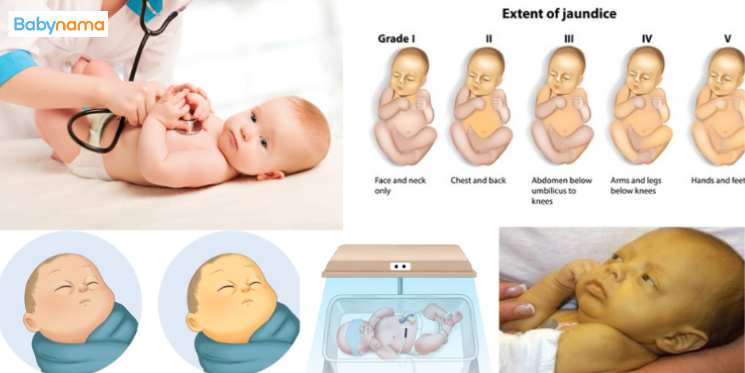
Most newborns develop some visible jaundice in the first week — it is one of the commonest things parents notice. It typically appears 24-72 hours after birth, peaks around day 4-5, and usually resolves by day 10-14.
- Physiological jaundice (normal): appears after 24 hours, mild yellowing of face and chest, baby feeds well, is active
- Pathological jaundice (needs attention): appears within first 24 hours, spreads to arms, legs, palms, and soles, baby is sleepy or feeding poorly, or persists beyond 2 weeks
Your pediatrician will check bilirubin levels if needed. Sunlight through a window is not treatment — if phototherapy is recommended, it needs to be done properly in a hospital or with a home phototherapy unit.
Cord Care
Follow dry cord care (WHO recommendation):
- Keep the cord stump dry and exposed to air
- Fold the diaper below the stump
- No need to apply anything — no antiseptic, no oil, no turmeric
- It falls off naturally in 1-3 weeks
See your doctor if: the base of the cord is red, swollen, oozing pus, or smells bad. This could be omphalitis (cord infection), which needs treatment.
Normal Things That Look Scary
- Sneezing frequently — clearing nasal passages, not a cold
- Hiccups — very common, don’t need intervention
- Irregular breathing — periodic breathing with brief pauses (under 10 seconds) is normal in newborns
- Peeling skin — especially in post-term babies, common and harmless on its own
- Breast swelling in baby — maternal hormones, resolves on its own
Vaccination Schedule
Vaccines due at birth (IAP schedule):
| Vaccine | Protects Against |
|---|---|
| BCG | Tuberculosis |
| Hepatitis B — Birth dose | Hepatitis B |
| OPV-0 | Polio (oral dose) |
These are usually given before hospital discharge. Make sure you receive a vaccination card — you’ll need it for tracking all future doses.
When to See a Doctor
⚠️ In a baby under 3 months, ANY fever of 100.4°F (38°C) or higher is a medical emergency — see a doctor the same day, even at night. Do not give paracetamol and wait. In a newborn, an axillary (underarm) temperature of 37.5°C or above, or feeling cold to touch (below 35°C) despite wrapping, also needs to be seen the same day.
These are WHO danger signs for newborns. Seek immediate medical attention if your baby shows any of the following:
- Unable to suck or refuses feeds repeatedly
- Breathing very fast (60+ breaths/min) or very slow (below 30) or grunting
- Blue discoloration of lips or tongue
- Fever (37.5°C or above) or feeling cold to touch (below 35°C) despite wrapping
- Seizures or unusual jerky movements
- Extreme lethargy — hard to wake even for feeds
- Vomiting everything — nothing stays down
- Jaundice appearing in the first 24 hours, or visible on palms and soles
- Cord area is red, swollen, or has pus/bad smell
🚨 Call 112 (national emergency) or 108 (ambulance), or go to the nearest hospital, if you see: difficulty/noisy breathing; swelling of face/lips/tongue; widespread hives with vomiting; pale/grey/blue skin; floppiness/unresponsiveness; or a seizure. If an adrenaline auto-injector is prescribed, use it first, then go.
In the first month, err on the side of calling your pediatrician. Newborns can deteriorate quickly, and what seems minor can need attention.
Aapke Sawaal
Baby bahut zyada rota hai — kya normal hai?
Newborns roz 1-3 ghante rote hain — yeh unka primary communication hai. Bhookh, diaper change, thakan, overstimulation — sab cheez ke liye rone ka ek hi tarika hai. Agar baby feed kar raha hai, diaper output normal hai, aur fever nahi hai, toh zyada rona usually normal hai. 6 weeks ke baad rona peak karta hai aur phir gradually kam hota hai.
Jaundice kitne din mein theek hota hai?
Normal (physiological) jaundice day 2-3 pe dikhta hai, day 4-5 pe peak karta hai, aur day 10-14 tak theek ho jaata hai. Agar baby ki aankhein peeli hain lekin woh achhe se feed kar raha hai aur active hai, toh usually ghar pe monitor kar sakte hain. Agar jaundice 2 hafte ke baad bhi hai, ya baby sust hai, ya haath-pair pe peela rang aa raha hai — toh turant doctor ko dikhayein.
Navjaat shishu ko kitni baar doodh pilana chahiye?
24 ghante mein 8-12 baar — yani har 2-3 ghante mein. Demand pe feed karein, schedule mat banayein abhi. Baby jab muh khole, hath muh mein daale, ya lip smacking kare — yeh bhookh ke signs hain. Rone tak wait mat karein — rona late sign hai.
Real Questions from Indian Mothers
These are real questions asked by parents in the Babynama community, answered by our pediatricians.
“My baby sleeps less after feeding and it seems she becomes more active and starts playing after feed Any suggestions or observations She is 2 months old and in BF”
Distractions are very normal in this age, try to feed in quiet room where interruptions are minimal. Keep room light dim. These measures will help to reduce Distractions and prolong feeding sessions
General information for Indian parents, not a substitute for your pediatrician. In an emergency, call 112 or 108.