Quick Answer
At 8 months, your baby is on the move — crawling, pulling to stand, and getting into everything. The pincer grasp is developing, which means they can pick up small bits of food (and small bits of everything else — time to baby-proof seriously). “Mama” and “dada” sounds are appearing, though they don’t mean you specifically yet. Separation anxiety is ramping up, and the 8-10 month sleep regression may arrive. On the food front, your baby is ready for thicker textures, finger foods, and self-feeding practice.
Development Milestones This Month
Movement & Motor Skills
This month is about mobility and fine motor development. Your baby is no longer content to sit in one spot — they want to get to things.
- Crawling — many babies are mobile now, in whatever style suits them. Classic hands-and-knees, army crawl, bear walk, bottom scoot — all are normal. Some babies skip crawling entirely
- Pulling to stand — grabs the sofa, crib rail, your pants, and hauls themselves upright. They can get up but often can’t get back down, which leads to frustrated crying (especially in the crib at 2 AM)
- Pincer grasp emerging — instead of raking food with their whole hand, baby starts using thumb and forefinger to pick up small pieces. This is huge for self-feeding
- Clapping — hands come together on purpose. Usually starts as imitation, then becomes spontaneous expression of excitement
- Sitting is rock solid — sits indefinitely, reaches in all directions without losing balance
Communication
Your baby is producing recognizable syllables. “Mama,” “dada,” “baba” — they sound like words but are used indiscriminately at this stage. Your baby will call the ceiling fan “mama” with equal enthusiasm. True word-meaning connection comes around 10-12 months.
- Varied intonation — babbling sounds like conversation with rising and falling tones
- Understands a few words — responds to “no” (may pause briefly before continuing to do the thing), recognizes “bye-bye,” turns when name is called
- Waves bye-bye — first as imitation, then spontaneously. Inconsistent at first
Social & Cognitive
Separation anxiety is building toward its peak (which hits around 9-10 months). Your baby may cling to you, cry when you leave the room, and protest being handed to others — even familiar relatives.
- Object permanence is developing — hide a toy under a cloth and baby lifts the cloth to find it. This is the same cognitive leap driving separation anxiety: baby knows you exist when you’re out of sight, but doesn’t yet trust that you’ll return
- Imitation is strong — baby copies your actions: clapping, banging, waving. They learn by watching you
- Pointing begins — baby points at objects they want or find interesting. This is an early form of communication
Feeding Guide
Three Meals a Day
Your baby should be on 3 meals per day plus breast milk or formula. Each meal is about 3/4 cup (180 ml). Breast milk is still important but food is becoming a significant calorie source.
Texture Upgrade
At 8 months, move to thicker mashed foods, soft lumps, and finger foods. Baby should be chewing with gums and managing small soft pieces. If you’re still on smooth purees, it’s time to advance.
Indian Foods for 8 Months
| Food | How to Serve | Notes |
|---|---|---|
| Khichdi with vegetables | Soft-cooked, mashed roughly, ghee on top | Add finely chopped spinach, carrot, or beans |
| Idli / dosa pieces | Tear into small bite-sized pieces | Serve with mild dal or coconut chutney (no spice) |
| Egg | Scrambled, boiled and mashed, or egg bhurji (no chilli) | Full egg is fine now — white + yolk |
| Roti strips | Thin strips of soft roti with dal or ghee | Chewing practice. Baby will gum it |
| Paneer cubes | Small soft cubes | Protein, calcium, fat. Great finger food |
| Fish | Boneless, steamed/poached, flaked | If non-veg family. Start with mild fish — rohu, surmai |
| Nut butters | Thin layer on roti or mixed into porridge | Peanut, almond. DO NOT give whole nuts — choking hazard |
| Curd + fruit | Fresh curd mixed with mashed banana or chikoo | Probiotic, calcium, easy to eat |
| Steamed veggie sticks | Carrot, sweet potato, broccoli — soft enough to mash with gums | Finger food practice |
Self-Feeding
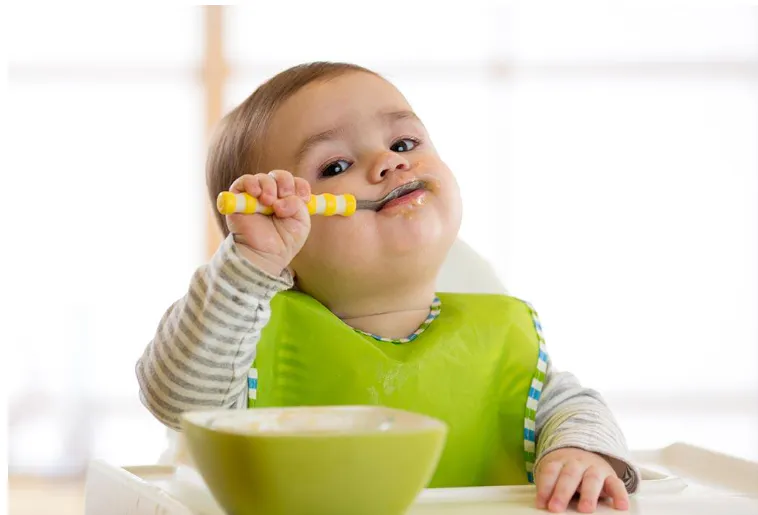
The pincer grasp is developing, which means your baby can pick up small pieces of food. Encourage self-feeding — put soft food pieces on the tray and let baby practice. Small pieces of banana, paneer cubes, idli bits, steamed vegetable sticks. It will be messy. This is how they learn.
Introduce a cup if you haven’t already. Open cup or a small steel glass. No sippy cups with valves — they don’t teach the right oral motor skills.
Allergen Introduction
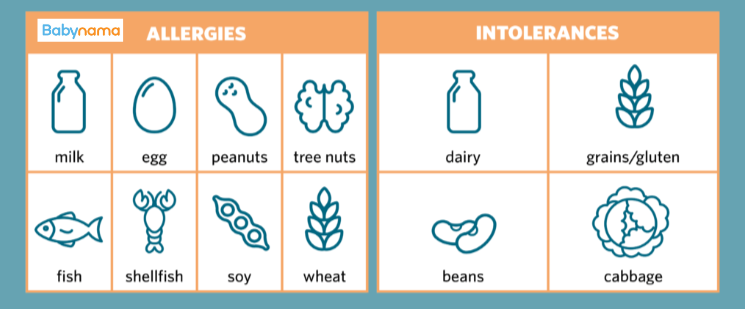
If you haven’t introduced common allergens yet, 8 months is a good time:
- Egg — scrambled or boiled
- Peanut — as thin peanut butter mixed into food (never whole peanuts)
- Fish — steamed, boneless, flaked
- Curd/dairy — if not already introduced
Give a small amount early in the day, watch closely for the first 10–15 minutes and on and off for 2 hours, then continue offering regularly if there’s no reaction. Introduce only one new allergen at a time so you know the culprit if a reaction happens. Mild reactions (a few hives around the mouth, mild tummy upset) can be watched and discussed with your pediatrician.
🚨 Call 112 (national emergency) or 108 (ambulance), or go to the nearest hospital, if you see: difficulty/noisy breathing; swelling of face/lips/tongue; widespread hives with vomiting; pale/grey/blue skin; floppiness/unresponsiveness; or a seizure. If an adrenaline auto-injector is prescribed, use it first, then go.
Sleep This Month
Sleep Schedule
- Total sleep: 12–14 hours
- Night sleep: 10–11 hours (some babies still need 1 night feed, many can sleep through)
- Naps: 2 naps (morning and afternoon)
- Wake windows: 2.5–3 hours
The 8–10 Month Sleep Regression
This is a real one. Your baby who was sleeping through the night may suddenly start waking 3-4 times. Causes:
- Separation anxiety — baby wakes, realizes you’re not there, panics
- Motor milestones — baby pulls to stand in the crib and can’t figure out how to get back down. Practices crawling at 3 AM
- Teething — front teeth (incisors) are coming through. Teething can cause drooling, gum discomfort and fussiness, but it does not cause a true fever, vomiting, or diarrhoea — if your baby has a fever of 100.4°F (38°C) or higher, don’t blame teething; check with your pediatrician for an infection
- Object permanence — baby knows you exist somewhere and wants you
What helps:
- Keep bedtime routine consistent — don’t change what was working
- Practice sitting down from standing during the day (so baby can do it in the crib at night)
- Brief, boring check-ins if baby wakes — reassure, don’t stimulate
- This lasts 2-6 weeks. It passes
Common Concerns
”My baby isn’t crawling — everyone else’s baby is”
Crawling is not a mandatory milestone. Some babies crawl at 6 months, others at 10, and about 10% skip it entirely and go straight to walking. What matters is that your baby is mobile in some way — rolling, scooting, army crawling — or showing interest in moving toward things. If your baby is sitting independently and reaching for things, development is on track. If there’s zero interest in mobility by 10-11 months, discuss with your pediatrician.
”Separation anxiety is exhausting”
It is. Your baby screams when you go to the bathroom, clings to you when visitors come, and melts down at daycare drop-off. This is one of the hardest phases for parents, but it’s temporary and it’s a sign of healthy attachment.
What helps:
- Say goodbye — always. Sneaking out makes it worse because baby can’t trust that you won’t disappear
- Keep goodbyes brief and confident — “Mama jaa rahi hai, wapas aayegi” and leave. Don’t linger
- Practice short separations — leave the room for 30 seconds, come back, build up
- Peek-a-boo — literally teaches object permanence (you go away and come back)
“Baby wakes up standing in the crib and screams”
Classic 8-month problem. Baby has learned to pull to stand but hasn’t figured out how to sit back down. During the day, practice the motion — help baby go from standing to sitting by bending knees and lowering down. At night, calmly help them down. Don’t make it interactive or fun, or it becomes a game.
Vaccination Schedule
No major vaccines are specifically due at 8 months on the IAP schedule. This is a quiet month between the 6-month and 9-month vaccine visits.
| Status | Notes |
|---|---|
| Catch-up | If any vaccines from 6 months are pending, get them done now |
| Next due | MMR-1 at 9 months (per IAP). JE-1 around 9 months only if you live in a JE-endemic district — check with your pediatrician |
If your baby hasn’t received the Influenza vaccine yet, it can still be started now (two doses, 4 weeks apart).
The exact schedule can vary by region and brand — your pediatrician follows the current IAP schedule, which is the authority. This page is a guide, not a fixed timetable.
When to See a Doctor
Contact your pediatrician if your 8-month-old:
- Does not sit without support — independent sitting should be established by now
- Does not bear weight on legs when held in standing position
- Makes no babbling sounds — should have consonant sounds by now
- Does not respond to own name
- Does not look for objects that you drop or hide
- Shows no interest in interactive games like peek-a-boo
- Does not transfer objects between hands
- Has lost skills previously achieved — any regression warrants evaluation
- Has persistent squint — eyes should be tracking together by now
Aapke Sawaal
8 months mein baby crawl nahi kar raha — tension lein?
Nahi. Crawling mandatory milestone nahi hai. Kuch babies 6 months mein crawl karte hain, kuch 10 months mein, aur kuch crawl karte hi nahi — seedha chalna seekh lete hain. Important ye hai ki baby independently baith raha ho aur cheezein pakadhne ki koshish kare. Agar baby kisi bhi tarah move karne ki koshish nahi kar raha 10-11 months tak, toh doctor se baat karo. Abhi ke liye relax karo.
Baby raat mein khada ho jaata hai crib mein aur rota hai — kya karein?
Ye bahut common hai 8 months mein. Baby ne khade hona seekh liya hai lekin wapas baithna nahi aata. Din mein practice karao — baby ko standing se sitting mein aana sikhao, ghutne mod ke neeche aana. Raat ko agar baby khada ho jaaye toh calmly baithao, zyada baat mat karo, lights mat jalao. Game mat banao isko warna baar baar karega. 1-2 hafton mein baby khud baithna seekh jaayega.
Kya 8 months mein anda aur fish de sakte hain?
Haan, bilkul. Full egg (white + yolk) 8 months mein de sakte hain — scrambled ya boiled mash karke. Fish bhi de sakte hain agar aap non-veg family hain — boneless steamed fish (rohu, surmai) flake karke do. Peanut butter bhi roti pe thin layer laga ke ya porridge mein mila ke de sakte hain — lekin whole nuts mat do, choking risk hai. Pehli baar koi bhi naya food do toh chhoti quantity do, 2 ghante wait karo, koi rash ya ulti ho toh ruko aur doctor se baat karo.
Real Questions from Indian Mothers
These are real questions asked by parents in the Babynama community, answered by our pediatricians.
“heloo doc my baby is almost 8 months whenever i feed her anything or give her milk she poops what is tha reasn”
This is normal, babies can pass multiple times stool due to gastrocolic reflex, if baby is feeding well, taking naps after feeds well and pee count is more than 6 to 8 times per day then nothing to worry
“Hi, should we burp baby even after 6 months ?”
While some babies need to be burped until about 6 months, many are showing signs that they’re able to relieve their own gas by 3-4 months. Remember, it’s about individual development and not age
“How can I encourage my 6 month baby to sit?”
You can help her sit with Support. Help her by giving a big soft toy between her legs for support Later you can remove that ball. And help her sit keeping her hands in between for support
General information for Indian parents, not a substitute for your pediatrician. In an emergency, call 112 or 108.