Quick Answer: Baby massage (malish) is a wonderful bonding activity that can help your baby relax, sleep better, and relieve gas. Start when your baby is at least 2 weeks old, and massage 1-2 times daily for 10-15 minutes. Best times are before bath or bedtime. Use natural oils like coconut or sesame oil (til ka tel), and always ensure baby is calm and alert - never massage a hungry or sleepy baby!
Why Is Baby Massage Important?
In India, baby massage (malish) has been a cherished tradition for generations. And science now confirms what our grandmothers always knew - massage has real benefits for babies!
Benefits of Baby Massage
| Benefit | How It Helps |
|---|---|
| Better sleep | Relaxes baby, promotes deeper sleep |
| Reduces gas and colic | Helps move trapped air through digestive system |
| Stronger bonding | Skin-to-skin contact releases love hormones |
| Improved circulation | Stimulates blood flow throughout body |
| Better weight gain | In premature babies, massage has been linked to faster weight gain |
| Reduced crying | Calming effect reduces fussiness |
| Muscle development | Gentle movements support motor development |
| Skin health | Oil keeps skin moisturized and healthy |
Research says: Studies show that regular infant massage can help premature babies gain weight faster and may reduce stress hormones in all babies.
When Can You Start Baby Massage?
Ideal Starting Age
| Baby Type | When to Start |
|---|---|
| Full-term babies | After 2 weeks (once umbilical stump falls off) |
| Premature babies | Consult your pediatrician first |
Best Time of Day for Massage
Recommended times:
-
Before bath time (morning or evening)
-
Before bedtime (helps sleep)
-
Between feeds (not immediately after) Avoid massage when:
-
Baby is hungry or just fed
-
Baby is sleepy or overtired
-
Baby is unwell or has fever
-
Baby is fussy and not settling
How Often Should You Massage?
| Age | Frequency | Duration |
|---|---|---|
| Newborn (2-4 weeks) | Once daily | 5-10 minutes |
| 1-3 months | 1-2 times daily | 10-15 minutes |
| 3-6 months | Once daily | 15-20 minutes |
| 6+ months | As baby enjoys | 15-20 minutes |
Tip: Follow your baby’s cues. If they seem to enjoy it, continue. If they’re fussy, try again later.
Which Oil to Use?
Traditional Indian Oils
| Oil | Benefits | Best For |
|---|---|---|
| Coconut oil (Nariyal tel) | Moisturizing, cooling, antimicrobial | Summer, normal skin |
| Sesame oil (Til ka tel) | Warming, strengthening, traditional | Winter, dry skin |
| Almond oil (Badam tel) | Rich in Vitamin E, gentle | Sensitive skin |
| Mustard oil (Sarson ka tel) | Used traditionally, but can irritate delicate baby skin | Use only diluted, with caution; many pediatricians prefer coconut oil |
Safety Tips for Oils
- Always do a patch test - Apply small amount on baby’s arm, wait 24 hours
- Avoid fragranced oils - Can irritate baby’s skin
- Never use essential oils - Too strong for babies
- Warm the oil slightly - Between your palms, not heated
- Avoid face area - Keep oil away from eyes, nose, mouth
Important: If using mustard oil, always dilute it and avoid in summer months. Many pediatricians recommend coconut oil as the safest option.
Step-by-Step Massage Technique
Getting Ready
- Choose a warm, quiet room
- Lay baby on soft towel or mat
- Remove any jewelry from your hands
- Warm oil between your palms
- Make sure baby is calm and alert
Head and Face (2-3 minutes)
- Gently stroke forehead with thumbs
- Circular motions on temples
- Stroke across cheeks (avoiding eyes)
- Gentle circles behind ears
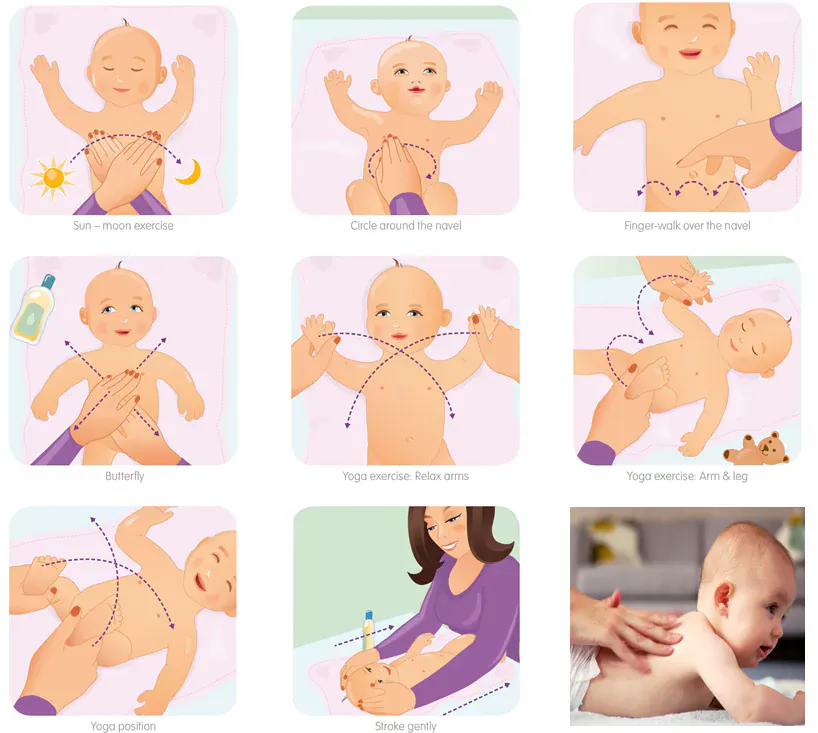
Chest and Tummy (3-4 minutes)
- Place hands flat on chest
- Stroke outward from center
- For tummy: Clockwise circular motions
- “I Love You” stroke for gas relief
Arms and Hands (2-3 minutes each)
- Hold arm gently at shoulder
- “Milking” stroke from shoulder to wrist
- Gently rotate wrist
- Open palm and stroke each finger

Legs and Feet (2-3 minutes each)
- Hold leg at thigh
- “Milking” stroke from thigh to ankle
- Gently rotate ankle
- Stroke sole of foot, then each toe
Back (3-4 minutes)
- Turn baby on tummy
- Long strokes from neck to bottom
- Small circles along spine (not on spine)
- Gentle strokes across shoulders
Special Massage for Common Problems
For Gas and Colic
The “I Love You” Massage:
-
I - Stroke down baby’s left side
-
L - Stroke across tummy, then down left side
-
U - Stroke up right side, across, and down left side Also try:
-
Bicycle legs
-
Knees to chest gently
-
Clockwise tummy circles
For Better Sleep
- Focus on back massage
- Use slower, longer strokes
- Dim lights and play soft music
- Make it part of bedtime routine
Signs Baby Is Enjoying Massage
| Positive Signs | Baby May Not Be Ready |
|---|---|
| Relaxed body | Crying or fussing |
| Cooing or smiling | Turning head away |
| Eye contact | Arching back |
| Calm breathing | Clenched fists |
| Falling asleep | Stiff body |
Common Mistakes to Avoid
- ❌ Massaging immediately after feeding
- ❌ Using cold oil
- ❌ Pressing too hard
- ❌ Massaging when baby is fussy
- ❌ Leaving baby unattended
- ❌ Using adult lotions or creams
Frequently Asked Questions
Q: Can I massage my baby every day?
A: Yes! Daily massage is safe and beneficial. Most Indian families massage babies twice daily - morning and evening.
Q: My baby cries during massage. What should I do?
A: Stop and try again later when baby is calmer. Some babies need time to get used to massage. Start with just legs or arms if full massage is too much.
Q: Should I massage my baby in winter?
A: Yes, but ensure the room is warm. Use warming oils like sesame oil. You can also massage in sunlight during morning hours.
Q: Can massage help my baby’s constipation?
A: Yes! Tummy massage in clockwise direction can help stimulate bowel movements. Bicycle legs also help.
Q: Is it okay to massage baby’s head and fontanelle?
A: Yes, gentle massage on the head is safe. Avoid pressing directly on the fontanelle (soft spot), but gentle strokes around it are fine.
Key Takeaways
- Start after 2 weeks when umbilical cord has healed
- Massage 1-2 times daily for 10-15 minutes
- Use natural oils - coconut or sesame oil are best
- Best timing: Before bath or bedtime, between feeds
- Follow baby’s cues - stop if baby is fussy
- Benefits are real - better sleep, less gas, stronger bonding
This article was reviewed by pediatricians at Babynama. Last updated: January 2026
General information for Indian parents, not a substitute for your pediatrician. In an emergency, call 112 or 108.
Need personalized guidance? Book a consultation with our pediatricians or explore our Care Plans for 24/7 expert support!