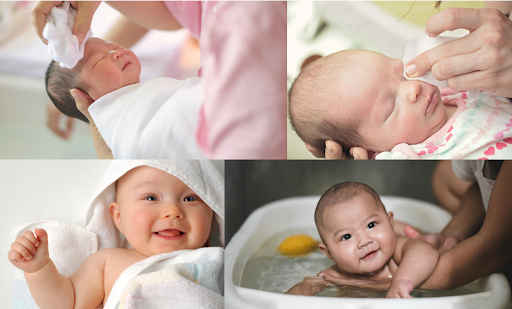
Quick Answer: Clean your newborn gently and only as needed. For eyes, wipe from inner to outer corner with damp cotton. For nose, use saline drops and a bulb syringe if congested - don’t insert anything into nostrils. For ears, clean only the outer part. Sponge baths are sufficient until the umbilical cord falls off. Never use earbuds inside a baby’s ears or nostrils.
Why Newborn Hygiene Matters
Newborns have delicate skin and developing immune systems. Proper hygiene helps prevent infections while being gentle enough for their sensitive bodies.
General Principles
| Do | Don’t |
|---|---|
| Be gentle | Use force |
| Use clean materials | Reuse dirty cotton |
| Clean only as needed | Over-clean |
| Use plain water mostly | Use harsh products |
| Pat dry gently | Rub vigorously |
Cleaning Baby’s Eyes
Daily Eye Care
Newborns often have some discharge in the corners of their eyes - this is normal.
How to Clean:
- Wash your hands thoroughly
- Dip cotton ball in cooled boiled water
- Gently wipe from inner corner to outer corner
- Use a fresh cotton ball for each eye
- Pat dry with clean cloth
Common Eye Issues
| Issue | What to Do |
|---|---|
| Sticky discharge | Normal; clean gently |
| Yellow/green discharge | May be infection; see doctor |
| Blocked tear duct | Gentle massage; usually resolves |
| Red, swollen eyes | See doctor immediately |
Note: Always wipe from inside (near nose) to outside (toward ear) to avoid spreading any infection.
Most blocked tear ducts clear on their own by about 12 months with gentle massage over the inner corner. See your doctor if there is pus, swelling or redness near the inner corner of the eye, or if it persists past a year.
In the first 1-2 weeks of life, heavy pus or marked swelling of the eyes needs same-day medical review — newborn eye infections in this period can occasionally be serious.
⚠️ Never apply kajal, surma or kohl to your baby’s eyes, and never put kajal, oil or anything into the nostrils. Kajal/surma can contain lead and irritate the eyes, and nothing should be inserted into a newborn’s eyes or nose.
Cleaning Baby’s Nose
Babies are obligate nose breathers - they can’t breathe through their mouths like adults. A blocked nose can make feeding and sleeping difficult.
When to Clean
- When you hear snuffling sounds
- When feeding is difficult
- When you see visible mucus
- Before feeding if congested
How to Clear Baby’s Nose
Method 1: Saline Drops
Use sterile/normal saline (0.9%) drops — buy a baby saline nasal spray/drops from the pharmacy (such as Nasoclear or Otrivin Saline) rather than mixing salt water at home, so the concentration is right. The wrong concentration can irritate the delicate nasal lining.
- Lay baby on back
- Put 1-2 drops saline in each nostril
- Wait 30-60 seconds
- Baby may sneeze out mucus naturally
Suction at most 2-3 times a day, and not right before every feed — frequent suctioning can swell and irritate the nasal lining. Method 2: Bulb Syringe/Nasal Aspirator
- Use saline drops first to loosen mucus
- Squeeze bulb before inserting
- Gently insert tip at nostril opening (not deep)
- Release squeeze to suction mucus
- Clean aspirator thoroughly after use
What NOT to Do
- Never insert cotton swabs into nostrils
- Don’t use adult nasal sprays
- Avoid suctioning too frequently (irritates nose)
- Don’t blow into baby’s face to clear nose
Cleaning Baby’s Mouth
Daily Mouth Care
Even before teeth appear, gentle mouth cleaning helps establish good habits and removes milk residue.
How to Clean:
- Wash your hands
- Wrap clean, damp gauze around your finger
- Gently wipe gums, tongue, and inside of cheeks
- Do this 1-2 times daily, ideally after feeding
Common Mouth Issues
| Issue | Signs | Action |
|---|---|---|
| Milk residue | White coating that wipes off | Normal; clean gently |
| Oral thrush | White patches that don’t wipe off | See doctor for treatment |
| Tongue tie | Difficulty feeding, heart-shaped tongue | Doctor evaluation |
Cleaning Baby’s Ears
Safe Ear Cleaning
Only clean what you can see - the outer ear and behind the ear.
How to Clean:
- Dampen a soft washcloth
- Gently wipe the outer ear folds
- Clean behind the ear (milk and sweat collect here)
- Pat dry gently
What About Earwax?
| Fact | What to Do |
|---|---|
| Earwax is normal | Leave it alone |
| It protects the ear canal | Don’t try to remove it |
| Ears are self-cleaning | Wax moves out naturally |
Warning: NEVER insert cotton buds/earbuds into baby’s ear canal. This can push wax deeper, damage the eardrum, or cause injury.
Bathing Your Newborn
Before the Cord Falls Off (First 1-2 Weeks)
Use sponge baths only to keep the umbilical stump dry.
How to Sponge Bath:
- Gather supplies (warm water, washcloths, towel, fresh clothes)
- Keep baby wrapped, expose one area at a time
- Wipe face first (eyes, ears, nose area)
- Clean neck folds, armpits, hands
- Clean diaper area last
- Pat dry thoroughly, especially in folds
After the Cord Falls Off
You can give baby a proper bath in a baby tub.
Bath Tips:
| Aspect | Recommendation |
|---|---|
| Temperature | 37-38°C (test with elbow) |
| Frequency | 2-3 times per week is enough |
| Duration | 5-10 minutes |
| Soap | Plain water or mild baby soap sparingly |
| Support | Always support head and neck |
If you don’t have a bath thermometer, the water should feel pleasantly warm — neither hot nor cool — when you dip your elbow or inner wrist. Always run or mix cold water first and then add hot, and never bathe baby straight from a geyser tap, to avoid scalding.
A traditional oil massage (malish) with a baby-safe oil before a bath is fine if your family follows it. Do not apply anything to the eyes or nose.
Areas That Need Extra Attention
- Neck folds - Milk and drool collect here
- Behind ears - Often overlooked
- Armpits - Can get sweaty
- Skin folds - Keep dry to prevent rashes
- Diaper area - Clean thoroughly
Umbilical Cord Care
How to Care for the Stump
| Do | Don’t |
|---|---|
| Keep clean and dry | Submerge in water |
| Fold diaper below stump | Cover with diaper |
| Let air circulate | Apply powder or lotion |
| Let it fall off naturally | Pull or tug at it |
⚠️ Apply nothing to the cord stump — no haldi (turmeric), ghee, ash, surma, powder or lotion. Keep it clean and dry only. Traditional applications raise the risk of cord infection and neonatal tetanus.
Signs of Infection
See doctor if you notice:
- Redness spreading around base
- Foul smell
- Yellow/green discharge
- Bleeding that doesn’t stop
- Baby seems unwell or has fever
⚠️ In a baby under 3 months, ANY fever of 100.4°F (38°C) or higher is a medical emergency — see a doctor the same day, even at night. Do not give paracetamol and wait. This applies even after a vaccine.
The cord usually falls off in 1-3 weeks.
Diaper Area Care
With Each Diaper Change
- Remove soiled diaper
- Wipe from front to back (especially for girls)
- Clean all folds and creases
- Pat dry completely
- Apply barrier cream if needed
- Put on fresh diaper
Preventing Diaper Rash
- Change diapers frequently
- Let baby have diaper-free time
- Pat dry, don’t rub
- Use barrier cream as protection
- Avoid wipes with alcohol or fragrance
Frequently Asked Questions
Q: How often should I bathe my newborn?
A: 2-3 times per week is enough. Daily baths can dry out baby’s skin. Spot clean face, neck, and diaper area daily.
Q: Can I use baby wipes on my newborn’s face?
A: It’s better to use plain water and cotton for the face. If using wipes, choose fragrance-free, sensitive skin varieties. Water is gentlest.
Q: My baby’s nose sounds congested but I can’t see anything - what do I do?
A: This is common. Use saline drops, run a humidifier, and keep baby upright after feeds. Babies often sound congested without actual blockage.
🚨 See a doctor urgently if your baby is breathing fast, grunting, has the ribs or chest pulling in with each breath, has blue or grey lips, or is feeding poorly or unusually drowsy. In a newborn who breathes mainly through the nose, congestion that affects breathing is not always harmless.
Q: When should I start brushing my baby’s teeth?
A: Start gentle mouth cleaning from birth. As soon as the first tooth appears (often around 6 months, but it varies), brush twice daily with a soft baby toothbrush and a rice-grain-sized smear of fluoride toothpaste.
Q: Is it normal for my newborn’s skin to peel?
A: Yes, mild flaking and peeling in the first weeks is very common, especially on the hands, feet and ankles, as your baby adjusts to life outside the womb. It usually needs no treatment. Tell your doctor if the skin is deeply cracked, raw, red, weeping, or if there are blisters.
Key Takeaways
- Less is more - Clean only as needed, don’t over-wash
- Gentle touch - Newborn skin and features are delicate
- No earbuds - Never put anything inside ears or nose
- Eyes: inside to outside - Prevents spreading infection
- Dry the folds - Moisture leads to rashes
- Sponge bath first - Until cord falls off
This article was reviewed by pediatricians at Babynama. Last updated: January 2026
This article is general information for Indian parents, not a substitute for examination by your pediatrician. In an emergency, call 112 or 108.
Need personalized guidance? Book a consultation with our pediatricians or explore our Care Plans for 24/7 expert support!