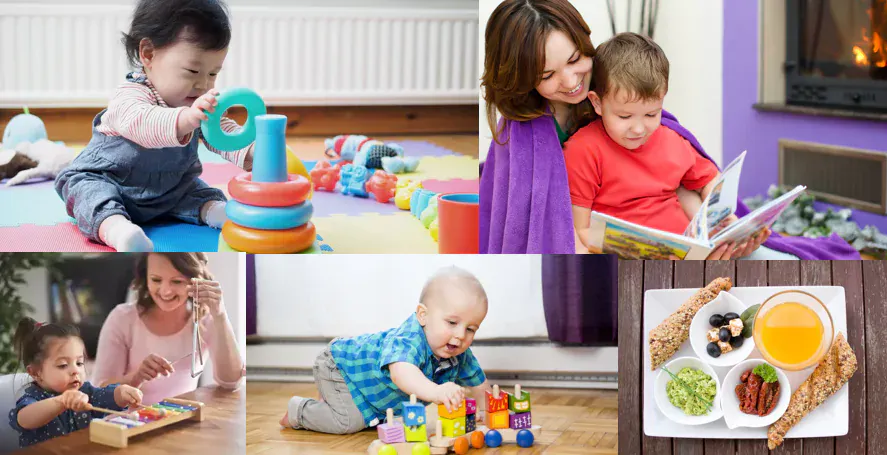
Quick Answer: Baby memory and concentration develop naturally through everyday interactions. Support this by talking to your baby frequently, playing simple games like peek-a-boo, reading together daily, establishing routines, limiting screen time, and ensuring adequate sleep. Don’t worry about “training” your baby’s brain - responsive, loving care with stimulating but not overwhelming activities is what builds cognitive skills.
Understanding Baby Memory and Concentration
Babies aren’t born with fully developed memory and attention - these skills build gradually through experience.
How Baby Memory Develops
| Age | Memory Capabilities |
|---|---|
| 0-3 months | Recognizes faces, voices, familiar smells |
| 3-6 months | Remembers objects and routines |
| 6-9 months | Shows object permanence (knows things exist when hidden) |
| 9-12 months | Remembers where things are hidden |
| 12-18 months | Longer-term memory emerging |
| 18+ months | Can remember and imitate actions from past |
How Attention Develops
| Age | Attention Span |
|---|---|
| Newborn | Seconds at a time |
| 3 months | 1-2 minutes |
| 6 months | 2-3 minutes |
| 1 year | 3-5 minutes |
| 2 years | 5-6 minutes |
| 3 years | 6-8 minutes |
Note: These are approximate. All babies develop differently, and attention varies based on interest!
Simple Activities by Age
0-3 Months
Focus: Face recognition, voice recognition, basic patterns
| Activity | How It Helps |
|---|---|
| Face time | Hold baby close, let them study your face |
| Talking/singing | Familiarity with your voice |
| High contrast images | Develops visual attention |
| Tummy time | Encourages looking around |
| Gentle touch | Body awareness |
3-6 Months
Focus: Object tracking, routine recognition
| Activity | How It Helps |
|---|---|
| Tracking toys | Move toy slowly for baby to follow |
| Mirror play | Fascination builds focus |
| Consistent routines | Bath, feed, sleep sequences |
| Reading together | Focus on pictures |
| Texture exploration | Different fabrics and surfaces |
6-12 Months
Focus: Object permanence, cause and effect
| Activity | How It Helps |
|---|---|
| Peek-a-boo | Memory that you exist when hidden |
| Hide and seek toys | Finding hidden objects |
| Stacking/nesting | Sequence and attention |
| Simple songs with actions | Memory through repetition |
| Container play | Put in, take out |
12-24 Months
Focus: Longer sequences, following simple directions
| Activity | How It Helps |
|---|---|
| Simple puzzles | Shape recognition, problem-solving |
| Following 2-step directions | ”Get the ball and bring it here” |
| Memory games | Simple matching |
| Story recall | ”What did the dog do?” |
| Sorting games | Colors, shapes, sizes |
Games That Build Memory
Peek-a-Boo Variations
| Variation | Age | How to Play |
|---|---|---|
| Classic | 4+ months | Hide face, reveal |
| With toy | 6+ months | Hide toy under cloth |
| Multiple hiding | 9+ months | Hide toy, move it, find |
| You hide | 12+ months | Let baby “find” you |
Memory-Building Games
| Game | Age | How to Play |
|---|---|---|
| Where’s the toy? | 6+ months | Hide under one of two cups |
| Which hand? | 9+ months | Object in one hand, guess which |
| Find the picture | 12+ months | Simple matching |
| Sequence recall | 18+ months | ”First we…, then we…” |
| What’s missing? | 2+ years | Remove one item, identify it |
Building Concentration
Environmental Factors
| Factor | How It Affects Focus |
|---|---|
| Quiet space | Less distraction = better focus |
| Uncluttered toys | Too many choices = scattered attention |
| Adequate sleep | Tired babies can’t concentrate |
| Full tummy | Hunger distracts |
| Comfortable temperature | Discomfort distracts |
Tips for Building Focus
For Play Time:
-
Offer 2-3 toys at a time, not dozens
-
Let baby lead the play
-
Don’t interrupt when deeply engaged
-
Rotate toys rather than having all available
-
Get down to baby’s level For Reading:
-
Start short (1-2 minutes is fine!)
-
Choose engaging, age-appropriate books
-
Follow baby’s interest
-
Stop if they’re done, even mid-book
-
Read the same favorites repeatedly
The Role of Routines
Why Routines Help Memory
Predictable sequences help babies:
- Know what to expect
- Remember the order of events
- Feel secure
- Build mental frameworks
Sample Routines
Morning:
Wake → Diaper → Feed → Play → Nap
Bedtime:
Bath → Massage → Pajamas → Feed → Story → Sleep
Routine Tips
- Keep sequence consistent
- Talk through what’s happening: “Now we’re having bath time. Next is pajamas!”
- Be flexible when needed
- Include baby in anticipating next steps
Nutrition for Brain Development
Key Nutrients
| Nutrient | Sources | Role |
|---|---|---|
| DHA (omega-3) | Breast milk, fatty fish, fortified formula | Brain cell membranes |
| Iron | Meat, fortified cereals, dal | Brain growth |
| Choline | Eggs, liver, beans | Memory function |
| Protein | Dairy, eggs, meat, dal | Neurotransmitters |
| Zinc | Meat, seeds, whole grains | Cognitive function |
Feeding Tips
- Breast milk or formula is the only food for the first 6 months — nothing else by mouth before then
- When starting solids at around 6 months, offer iron-rich Indian foods like ragi porridge, moong dal khichdi, and well-mashed dal
- Include DHA-rich foods (if appropriate for age and discussed with your pediatrician)
- Variety — suji, curd rice, mashed vegetables — supports overall development
Sleep and Brain Development
Why Sleep Matters
| Sleep Function | How It Helps |
|---|---|
| Memory consolidation | Moves short-term to long-term memory |
| Brain “cleaning” | Removes waste products |
| Neural development | Brain grows during sleep |
| Attention restoration | Rested babies focus better |
Sleep Needs
| Age | Total Sleep (24 hours) |
|---|---|
| 0-3 months | 14-17 hours |
| 4-12 months | 12-16 hours |
| 1-2 years | 11-14 hours |
Tips for Good Sleep
- Consistent bedtime routine
- Dark, quiet environment
- Regular schedule
- Watch for sleep cues
- Adequate daytime naps
What to Avoid
Screen Time
| Age | Recommendation |
|---|---|
| 0-18 months | Avoid screens except video chat |
| 18-24 months | Very limited, high-quality only, with parent |
| 2+ years | Limited to 1 hour/day of quality content |
Why limit screens:
- Can interfere with attention development
- Reduces face-to-face interaction
- May affect language development
- Sleep disruption from blue light
Overstimulation
| Signs of Overstimulation | What to Do |
|---|---|
| Looking away | Give a break |
| Crying/fussing | Move to calm environment |
| Arching back | Reduce stimulation |
| Glazed expression | Rest time |
Comparing to Others
- Every baby develops at their own pace
- “Einstein” products don’t make babies smarter
- Love and interaction matter most
- Early differences don’t predict future
Red Flags to Watch For
When to Consult a Doctor
- No response to loud sounds
- Doesn’t track objects by 3 months
- Doesn’t recognize familiar people by 6 months
- No interest in surroundings
- Loss of previously learned skills
Frequently Asked Questions
Q: Can I train my baby to have a better memory?
A: You don’t need to “train” babies - their brains develop naturally through loving interaction. Simple play, talking, reading, and routine are all the “training” needed. Avoid flashcard-type approaches for babies.
Q: My baby gets distracted easily - is this a problem?
A: Short attention spans are typical at this age! Babies are wired to notice new things. Attention span grows gradually with age. The activities above support this natural development.
Q: Do brain-development toys work?
A: Simple toys and everyday objects work just as well as expensive “educational” toys. Cardboard boxes, wooden spoons, and fabric scraps can be wonderful for development. Your interaction matters more than the toy itself.
Q: Will my baby’s memory improve if they watch educational videos?
A: No. Research shows babies learn better from live human interaction than from screens. Videos lack the back-and-forth that builds brain connections.
Q: How do I know if my baby’s memory is developing normally?
A: Look for age-appropriate milestones: recognizing faces by 3 months, object permanence around 8 months, remembering where things are by 12 months. If concerned, discuss with your pediatrician.
Key Takeaways
- Development is gradual - Memory and attention build over time
- Interaction is key - Talk, play, and read together
- Routines help - Predictability supports memory
- Sleep matters - Brain development happens during rest
- Less is more - Fewer toys = better focus
- Limit screens - Face-to-face trumps screen time
- Don’t compare - Every baby develops uniquely
This article was reviewed by pediatricians at Babynama. Last updated: January 2026
A note for Indian parents: This article is for general educational purposes and follows Indian Academy of Pediatrics (IAP) guidance where relevant. It is not a substitute for an in-person consultation. Every baby develops differently — if you have any concern about your child’s memory, attention, hearing, vision, or loss of previously learned skills, please consult your pediatrician. In an emergency, call 112 (national emergency) or 108 (ambulance) or go to your nearest hospital.
Need personalized guidance? Book a consultation with our pediatricians or explore our Care Plans for 24/7 expert support!
Related Tools