
Quick Answer
Start solid foods (weaning/complementary feeding) at around 6 months of age, when your baby shows signs of readiness - not before 4 months or after 8-9 months. Breastmilk or standard infant formula continues to be the primary nutrition source until age 1 - solids are supplementary at first. Don’t worry if your baby eats very little initially; the first few months are about exploration and learning, not nutrition.

When to Start Solids: Signs of Readiness
Baby is Ready When They Can:
- Sit with minimal support - Good head and neck control
- Show interest in food - Watches you eat, reaches for food
- Open mouth when food approaches - Anticipates feeding
- Lost tongue-thrust reflex - Doesn’t push food out automatically
- Coordinate swallowing - Can move food to back of mouth
Age Guidelines
| Age | Recommendation |
|---|---|
| Before 4 months | Never - digestive system not ready |
| 4-6 months | Only if doctor advises (rare situations) |
| Around 6 months | Ideal time - WHO/IAP recommendation |
| After 8-9 months | May have difficulty accepting solids |
Important: The 6-month mark is based on developmental readiness, not a fixed date. Some babies may be ready a week or two earlier/later.
Step-by-Step Guide to Starting Solids
Step 1: Prepare for Weaning
What you need:
-
Small bowl and spoon (silicone or soft plastic)
-
High chair or feeding seat
-
Bibs (lots of them!)
-
Patient mindset - this is messy business! Before the first feed:
-
Continue breastmilk/formula as usual
-
Choose a time when baby is alert but not too hungry
-
Morning or early afternoon works best
Step 2: First Foods (Day 1-7)
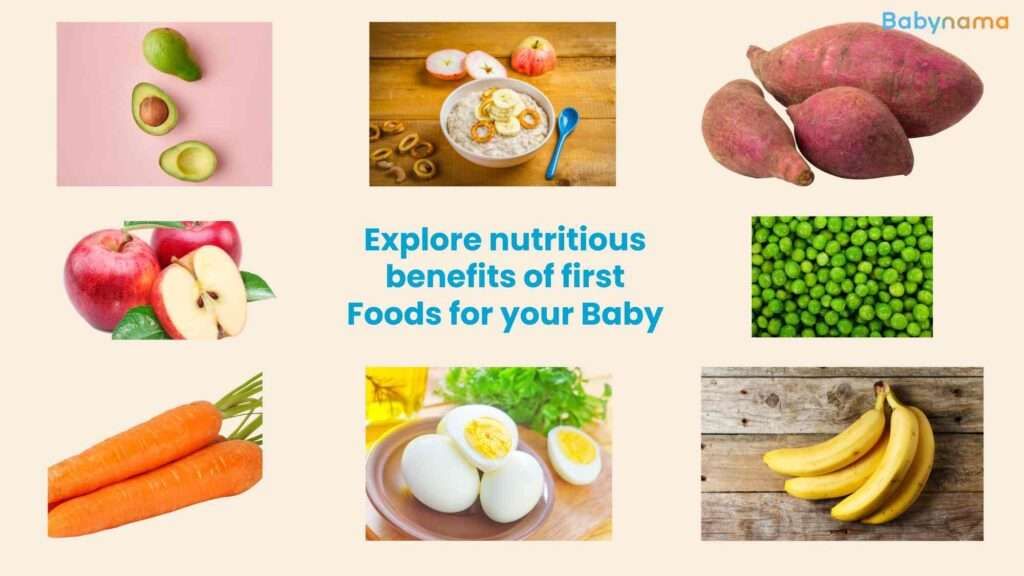
Start with single-ingredient purees:
| Food | Why It’s Good | How to Prepare |
|---|---|---|
| Ragi (nachni) | Iron-rich, Indian staple | Porridge with breastmilk/formula |
| Rice cereal | Easy to digest | Mix with breastmilk/formula |
| Banana | Natural sweetness, soft | Mash with fork |
| Sweet potato | Vitamin A, mild taste | Steam and mash |
| Dal water | Protein, familiar taste | Strain cooked moong dal |
Day 1: Offer 1-2 teaspoons after a milk feed
Days 2-4: Same food, gradually increase to 2-3 teaspoons
Days 5-7: Watch for any reaction, then introduce new food
Step 3: Expand Variety (Week 2-4)
3-Day Wait Rule: Introduce one new food at a time and watch for 2-3 days before adding another, so you can spot any reaction. This spacing is for watching a new food — it is not a reason to delay common allergen foods like egg or peanut (see the section below). Dietary diversity matters: keep widening the range of foods steadily.
Foods to introduce:
- Vegetables: Carrot, lauki, pumpkin, spinach (palak)
- Fruits: Apple, pear, papaya, chiku
- Grains: Oats, suji, jowar
- Proteins: Moong dal, masoor dal
Introducing Common Allergens (don’t delay these)
Current WHO, IAP and AAP guidance is clear: common allergen foods should be introduced around 6 months — not delayed — once your baby is tolerating a couple of first foods. Holding them back or leaving them out actually raises the risk of food allergy.
Once your baby has comfortably taken 2-3 first foods (usually by around 6 months), deliberately offer:
- Well-cooked whole egg (yolk and white) — mashed or softly scrambled.
- Peanut — as smooth peanut butter thinned with breastmilk/formula or water, or peanut powder stirred into porridge/dal. Never give whole or chopped nuts (choking hazard).
- Other allergens as they fit your family’s diet: dahi/curd and other dairy in cooking, wheat (suji), fish (if non-veg), sesame (til).
Once a baby tolerates an allergen, keep it in the diet a few times a week — regular exposure is what protects against allergy. Watch for a reaction the first few times, but don’t let the 3-day spacing become a reason to keep these foods out.
Talk to your pediatrician first if your baby has severe eczema or a known egg allergy before introducing peanut — they may want to guide the timing or do it under supervision.
Step 4: Increase Texture (Month 2-3)
Progress from:
- Thin purees (watery consistency)
- Thick purees (spoonable)
- Mashed foods (with soft lumps)
- Minced/chopped (by 8-9 months)
- Finger foods (soft, dissolvable)
Step 5: Establish Meal Routine
By 7-8 months:
- 2-3 solid meals per day
- Continue 4-5 breastmilk/formula feeds
- Offer water in sippy cup with meals
Choking Safety (please read)
- Always stay with your baby while they eat — never leave them alone, and never prop a bottle.
- Have your baby sit upright in a high chair to eat, never lying back or in a moving car/walker.
- Offer finger foods soft enough to squash between your fingers, cut into finger-length strips (easier to grip than small cubes) or, for round foods, quartered lengthwise — e.g. grapes and cherry tomatoes cut into quarters, not whole.
- Avoid hard, round or slippery choking hazards: whole nuts, whole grapes, popcorn, hard raw carrot/apple chunks, and large blobs of nut butter.
- Learn to tell normal gagging (noisy, baby recovers — part of learning) from choking (silent, can’t breathe or cry, going blue — an emergency). Consider learning infant choking first-aid/CPR. If your baby is choking and cannot breathe, call 112 or 108 and start infant first-aid immediately.
Best First Foods for Indian Babies
Traditional Indian Weaning Foods
| Food | Benefits | Recipe Ideas |
|---|---|---|
| Ragi | High calcium and iron | Ragi porridge, ragi kanji |
| Rice + dal khichdi | Complete protein | Soft khichdi with ghee |
| Suji | Easy to digest | Suji halwa (no sugar) |
| Moong dal | Gentle protein | Dal ka paani, dal puree |
| Seasonal vegetables | Vitamins, fiber | Steamed and mashed |
| Seasonal fruits | Natural sugars, vitamins | Fresh purees |
First Foods by Month
Month 6:
-
Ragi porridge
-
Rice cereal with breastmilk/formula
-
Banana mash
-
Dal water/puree
-
Vegetable purees (carrot, lauki, potato) Month 7:
-
Khichdi (rice + dal)
-
Mixed vegetable purees
-
Fruit combinations
-
Suji upma (very soft)
-
Dahi (small amounts) Month 8:
-
Idli (mashed)
-
Dosa pieces (soft)
-
Paneer (mashed)
-
Finger foods beginning
Note on egg: Well-cooked whole egg (yolk and white) does not need to wait until month 8. It can be introduced from around 6 months as one of the early allergen foods — mash or scramble it soft. Introducing egg early and keeping it in the diet is actually protective against egg allergy (see “Introducing Common Allergens” below).
What About Formula and Breastmilk?
Breastmilk/Formula Remains Primary
| Age | Milk Feeds | Solid Meals |
|---|---|---|
| 6 months | 5-6 feeds/day | 1 meal |
| 7-8 months | 4-5 feeds/day | 2 meals |
| 9-12 months | 3-4 feeds/day | 3 meals |
Total daily milk: 600-800ml until 12 months
If You Are Using Formula
Any standard infant formula appropriate for your baby’s age is fine — there is no need to pick a particular brand. Choose one in consultation with your pediatrician.
You do not need to “switch” formulas at 6 months. Standard (Stage 1) infant formula can continue right through the first year. Follow-on or “Stage 2” formulas are not nutritionally required, so there’s no need to change unless your pediatrician advises it for a specific reason.
Tips for Success
- Timing matters - Feed when baby is alert, not overtired or starving
- Patience is key - May take 10-15 tries to accept new food
- No forcing - Let baby guide quantity
- Add ghee - 1/4 teaspoon adds healthy fat and helps absorption
- Eat together - Babies learn by watching family eat
- Stay calm with mess - It’s part of learning!
Foods to Avoid Before 1 Year
| Food | Reason |
|---|---|
| Honey | Risk of botulism |
| Cow’s milk (as main drink) | Low in iron, can cause iron deficiency; high protein/mineral load. Small amounts in cooking (curd, paneer) are fine |
| Salt | Kidneys can’t process |
| Sugar | Creates sweet preference |
| Whole nuts | Choking hazard |
| Fruit juices | High sugar, low nutrition |
| Processed foods | Preservatives, additives |
Common Mistakes to Avoid
- Starting too early (before 4 months) - Digestive system not ready
- Starting too late (after 8-9 months) - May resist textures
- Replacing milk feeds too quickly - Milk is still primary nutrition
- Adding salt/sugar - Harmful for baby’s kidneys and health
- Forcing feeds - Creates negative association with food
- Giving honey - Risk of infant botulism
- Too many new foods at once - Can’t identify allergies
- Only sweet foods first - Creates preference, harder to accept vegetables
Dealing with Picky Eaters
Remember: Some pickiness is normal and developmental!
Strategies:
- Offer rejected food again after few days
- Mix new foods with accepted foods
- Let baby self-feed finger foods
- Make mealtimes pleasant, not pressured
- Eat together as family when possible
- Offer variety but don’t overwhelm
When to Consult a Doctor
See your pediatrician if:
- Baby refuses all solids for more than 3-4 weeks after turning 6 months
- Severe gagging or choking episodes
- Mild signs of food allergy (book a review, and stop that food):
- Rash or hives
- Vomiting
- Diarrhea
- Poor weight gain despite adequate feeding
- Baby shows no interest in food by 8 months
- You’re unsure about baby’s readiness
🚨 Call 112 (national emergency) or 108 (ambulance), or go straight to the nearest hospital, if you see: difficulty or noisy breathing; swelling of the face, lips or tongue; widespread hives with vomiting; pale, grey or blue skin; floppiness or unresponsiveness; or a seizure. These can be a severe allergic reaction (anaphylaxis). If an adrenaline auto-injector has been prescribed, use it first, then go. Do not wait for a clinic appointment.
Expert Insight: Breastmilk is recommended up to 6 months and alongside solids to 1 year and beyond. Where formula is needed, it is a safe and valid choice — there is no room for guilt. Fed is best.
FAQs
Q: My baby is 5.5 months and very interested in food. Can I start early?
A: If baby shows all readiness signs (sitting with support, lost tongue thrust, interest in food) and your pediatrician agrees, you may start a week or two before 6 months. However, never before 4 months as the digestive system isn’t ready. When in doubt, wait until 6 months.
Q: Baby only wants breastmilk and spits out all food. Is this normal?
A: Yes, very normal! Breastmilk is familiar and comforting. Keep offering solids without pressure. Try different times of day, different textures, and let baby play with food. Most babies gradually accept solids. If refusal continues beyond 3-4 weeks, consult your pediatrician.
Q: Should I reduce formula when starting solids?
A: Not immediately. For the first month of solids, continue the same formula feeds. As baby eats more solids (by 8-9 months), some milk feeds may naturally decrease. Target 600-800ml breastmilk/formula daily until 12 months. Milk still provides most of the nutrition that early solids can’t yet replace.
Q: Can I give store-bought baby food or should I make fresh?
A: Homemade is preferred - it’s fresher, cheaper, and you control ingredients. However, good-quality store-bought foods (Nestle Cerelac, Slurrp Farm, etc.) can be convenient occasionally. Check labels for no added salt/sugar. Avoid relying on them daily.
Q: My mother-in-law wants to give janam ghutti and cerelac at 3 months. How do I handle this?
A: This is a common concern! Explain that medical guidelines have changed - starting solids before 6 months increases risk of allergies, digestive problems, and infections. Share that WHO, IAP (Indian Academy of Pediatrics), and your doctor recommend waiting until 6 months. You can involve your pediatrician in the discussion if needed.
Q: What if baby has constipation after starting solids?
A: Some constipation is common when starting solids. Try: offering water between feeds, giving fiber-rich foods (papaya, prunes, pear), avoiding too much banana/apple, ensuring adequate breastmilk/formula, and gentle tummy massage. If constipation persists, consult your pediatrician.
This article was reviewed by a Babynama pediatrician. Last updated: February 2026.
Sources: WHO Guideline for complementary feeding of infants and young children 6-23 months of age (2023); IAP Infant and Young Child Feeding guidelines; AAP HealthyChildren — “When to Introduce Egg, Peanut Butter & Other Common Food Allergens.”
This article is general information for Indian parents, not a substitute for examination by your pediatrician. In an emergency, call 112 or 108.
Need personalized guidance? Book a consultation with our pediatricians or explore our Care Plans for 24/7 expert support!
Related Tools
Starting Solids? We Can Help!
Expert-guided nutrition plans for your baby.
Explore Nutrition Program