Quick Answer
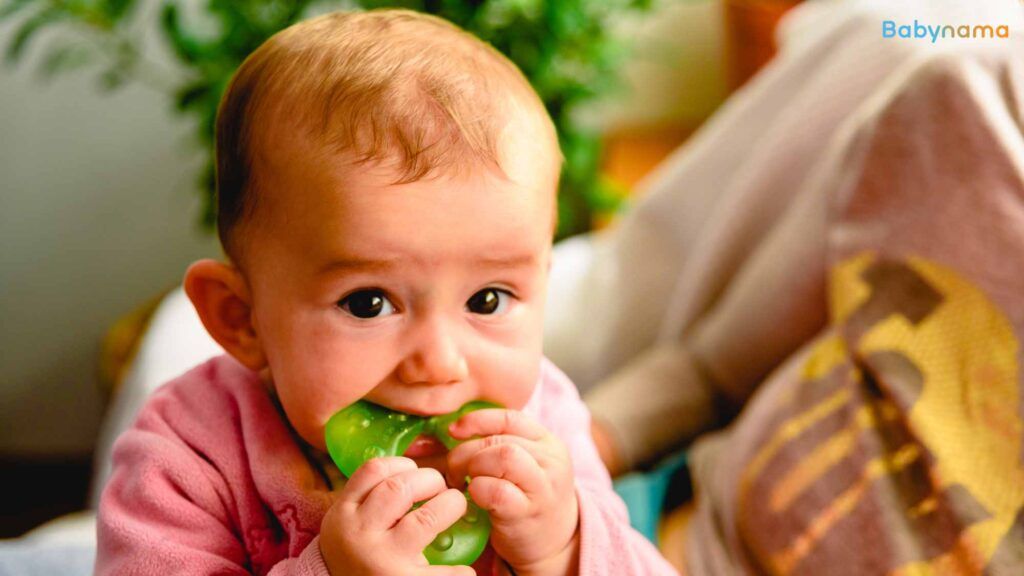
Your 5-month-old is on the move. They’re rolling front to back, reaching for toys with genuine intent, and putting everything in their mouth. This is the oral exploration phase — baby is literally tasting the world. Drooling has increased, gums might be tender, and you may be wondering if those are teething signs. Maybe. First teeth typically show up at 6–10 months, but the gum discomfort can start now. Meanwhile, baby is watching you eat with laser focus and you’re wondering if it’s time for solids. Not yet — one more month.
Development Milestones This Month
Movement & Motor Skills
- Rolling is happening — tummy to back is usually mastered first. Back to tummy takes more core strength and may come in the next few weeks
- Tummy time is impressive — strong head and chest lift, pushing up on extended arms. They’ll pivot on their belly to reach toys. Aim for 40–60 minutes across the day
- Reaching is purposeful — not just batting anymore. Baby sees a toy, reaches for it, grabs it. Hand-eye coordination is visibly better
- Weight bearing — when held upright on your lap, they’ll push down with their legs. This isn’t “standing” — it’s practicing leg strength
Communication
- Early consonant sounds — you’ll start hearing “ba,” “da,” “ga” mixed in with vowel sounds. Not words yet, but building blocks
- Squealing — high-pitched, delighted sounds. Also high-pitched, frustrated sounds. Volume control hasn’t arrived
- Raspberries — blowing spit bubbles is a genuine developmental milestone. Messy, but it means they’re learning to control lips and tongue
Social & Cognitive
- Emotional understanding — baby responds differently to your happy voice vs. stern voice. They read your tone before they understand your words
- Mirror fascination — they don’t know it’s them yet, but they love watching that baby in the mirror
- Mouthing everything — this is how 5-month-olds learn about objects. Texture, temperature, shape — all processed through the mouth. It’s not random; it’s research
Feeding Guide
Still exclusive breastfeeding or formula. One more month.
Your baby is showing what looks like readiness for solids — staring at your food, reaching for your plate, maybe even opening their mouth when you eat. These are signs of interest, not readiness. True readiness requires:
- Sitting with support and good head control — almost there but not quite
- Loss of tongue-thrust reflex — baby stops pushing food out with their tongue. Usually happens closer to 6 months
- Able to bring objects to mouth intentionally — this one’s checked
All three need to be present. Most babies hit all three right around 6 months. Resist the pressure to start early, even if baby seems “ready.”
What’s normal at 5 months:
- Feed frequency may drop slightly — baby is more efficient and feeds faster
- Growth rate slows compared to first 3 months — this is expected, not a sign of insufficient milk
- Baby is easily distracted during feeds — they’d rather look at the ceiling fan than eat
Sleep This Month
The 4-month sleep regression should be settling down. If it’s not, give it another week or two.
Sleep Schedule
- Total sleep: 13–14 hours
- Night: 10–11 hours (1–2 night feeds is still normal)
- Naps: 2–3 naps, some babies dropping the late afternoon catnap
- Wake windows: 2–2.5 hours
What’s Changing
- Naps are becoming more predictable — you might notice a pattern forming with a morning nap, afternoon nap, and maybe a short late nap
- Night sleep may consolidate — longer stretches between feeds
- Baby may start rolling in the crib. Once they can roll both ways, let them sleep in whatever position they choose. If they can only roll one way, gently reposition
Common Concerns
Teething — Is It Starting?
Maybe. Common signs of teething:
- Increased drooling — though this also happens due to salivary gland maturation
- Chewing on everything — but 5-month-olds do this regardless
- Fussiness and irritability — particularly in the evenings
- Swollen, tender gums — run a clean finger along the gums. If you feel a hard bump, a tooth is coming
- Mild ear pulling — referred gum pain
What teething does NOT cause: fever, diarrhoea, or severe illness. Teething may cause a slight rise in temperature, but a true fever — 100.4°F (38°C) or higher — is never “just teething.” If your baby has a fever, vomiting, diarrhoea, or seems genuinely unwell, it’s an infection or something else — see a doctor, don’t blame the gums.
What helps: Chilled (not frozen) teething rings, clean cold washcloth to chew on, gentle gum massage with your clean finger. Teething gels with benzocaine/lidocaine are not recommended for infants (risk of harm). For genuine discomfort, paracetamol can help, but check with your pediatrician first.
Paracetamol is dosed by your baby’s weight, not age: 15 mg/kg per dose, every 4–6 hours, max 4 doses (60 mg/kg) in 24 hours. Check the syrup strength (120 vs 250 mg/5 ml). Not for under-3-months without a doctor. Confirm the exact mL with your pediatrician.
Some families rub honey, jaggery, or traditional pastes on the gums — these are widely used but have no proven benefit, and honey must never be given before 12 months (infant botulism risk). Discuss any remedy with your pediatrician.
First tooth typically appears at 6–10 months, usually a lower central incisor.
”Baby puts everything in their mouth — should I stop this?”
No. Oral exploration is a critical part of development at this age. Baby learns about objects through mouthing — it’s how they process texture, shape, and temperature. Your job is to make sure what goes in the mouth is safe:
- No small objects (choking hazard — anything that fits through a toilet paper roll)
- Keep floors clean
- Avoid sharp-edged toys
- Wash toys regularly
Let them explore. Restrict the environment, not the behaviour.
”Baby is watching me eat and grabbing my plate”
Exciting, but it doesn’t mean they need food today. Interest in food is a social behaviour — they want to do what you’re doing. True readiness for solids involves physical milestones (head control, sitting, loss of tongue-thrust reflex) that usually align around 6 months. You’re almost there.
Vaccination Schedule
No vaccines are specifically due at 5 months on the IAP schedule. Your next vaccine visit is at 6 months.
When to See a Doctor
Contact your pediatrician if your 5-month-old:
- Does not reach for objects — hands should be actively grabbing by now
- Does not show affection toward caregivers — no smiling, no excitement when you appear
- Does not respond to sounds around them
- Does not laugh or make happy sounds
- Seems very stiff or very floppy — consistently unusual muscle tone
- Has not rolled in either direction — at least tummy to back should be happening
- Has persistent head tilt to one side — could indicate torticollis
Milestones are ranges, not deadlines — most healthy babies vary by a few weeks. The flags above are about a pattern of no progress, not a single skill arriving late.
🚨 Call 112 (national emergency) or 108 (ambulance), or go to the nearest hospital, if you see: difficulty/noisy breathing; swelling of face/lips/tongue; widespread hives with vomiting; pale/grey/blue skin; floppiness/unresponsiveness; or a seizure. If an adrenaline auto-injector is prescribed, use it first, then go.
Aapke Sawaal
5 mahine mein daant aa rahe hain — kya ye jaldi nahi hai?
Nahi, kuch babies mein 4–5 mahine mein hi gums mein activity shuru ho jaati hai. First tooth usually 6–10 months mein aata hai, but gum mein swelling aur discomfort pehle se ho sakta hai. Agar baby zyada irritable hai, drooling badh gayi hai, aur cheezein chaba raha hai — ye normal teething signs hain. Chilled teething ring do. Teething gel mat lagao.
Baby har cheez muh mein daalta hai — kya ye normal hai?
Bilkul normal hai. 5 mahine mein oral exploration phase hota hai — baby duniya ko muh se samajhta hai. Shape, texture, temperature — sab muh se test karta hai. Aapka kaam hai safe environment banana — chhoti cheezein hatao, toys saaf rakho, floor saaf rakho. Baby ko explore karne do.
Kya ab solid food shuru kar sakte hain?
Abhi nahi. WHO kehta hai 6 months complete hone par shuru karo. Baby food mein interest dikha raha hai — ye social behaviour hai, readiness nahi. Readiness ke liye baby ka head control strong hona chahiye, support se baith sake, aur tongue-thrust reflex khatam ho. Ye sab usually 6 months ke aas-paas hota hai. Ek mahina aur wait karo.
Real Questions from Indian Mothers
These are real questions asked by parents in the Babynama community, answered by our pediatricians.
“hi, how much tummy time is required for a 1.5 months old?”
You might begin with 1 to 2 minutes a few times a day. Over time, you can gradually build up to 10 to 15 minutes, several times a day. You might start by laying your baby across your lap on their tummy.
“Doc my baby sweat alot he is 4 month old is it normal for babies to sweat alot”
Sweating while feeding is normal in babies provided baby active, gaining weight, feeding well for atleast 15-20 minutes, no breathing difficulty, or recurrent history of cough and chest infections
General information for Indian parents, not a substitute for your pediatrician. In an emergency, call 112 or 108.