Quick Answer
This is the month everything changes — your 6-month-old is ready for solid food. After 6 months of exclusive breastfeeding, your baby’s gut, kidneys, and motor skills are finally mature enough for complementary feeding. But breastmilk still provides most of the nutrition — solids are an addition, not a replacement. Beyond food, your baby is rolling both ways, sitting with support, recognising familiar faces, and developing an opinion about strangers. Bade bade milestones hain — enjoy karo.
Development Milestones This Month
Movement & Motor Skills
- Rolling both ways — tummy to back and back to tummy. Some babies become rolling machines, covering the entire room
- Tripod sitting — sits with hands on the floor for support. Not independent sitting yet, but getting close
- Straight arm push-ups — during tummy time, arms are fully extended, chest well off the ground
- Reaching is precise — sees a toy, reaches for it, grabs it, brings it to mouth. Smooth, coordinated sequence
Communication
- Turn-taking — baby makes a sound, waits for you to respond, then “talks” again. This is conversation, even though no words exist yet
- Raspberries and varied sounds — a full repertoire of squeals, coos, growls, and spit-filled raspberries
- May respond to own name — not consistently, but they’re starting to recognise it
Social & Cognitive
- Familiar vs. unfamiliar — baby clearly knows family members and may show hesitation or wariness around strangers. This is healthy brain development
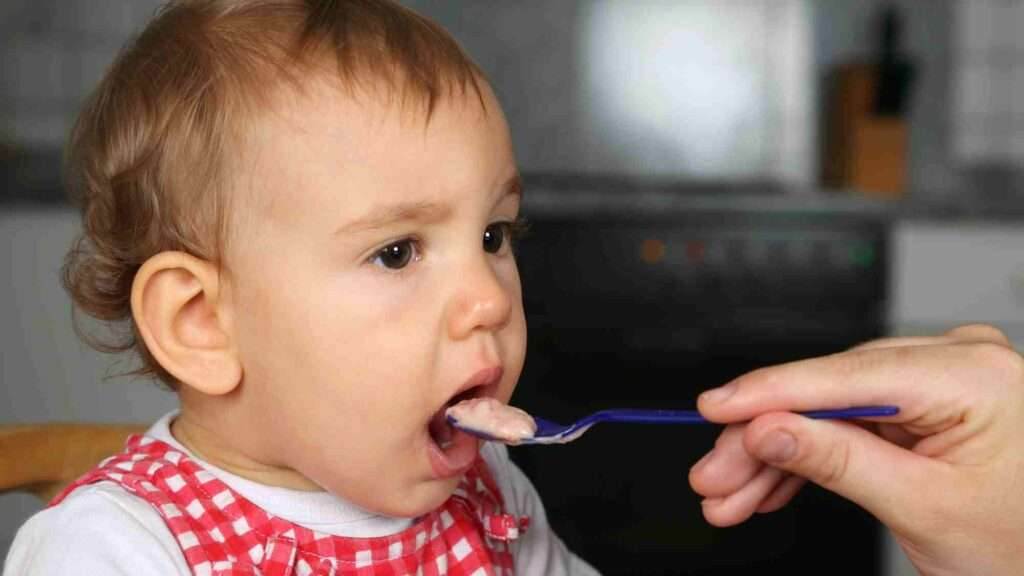
- Refuses food — closes lips, turns head away. They have preferences and they’ll show them. Respect this
- Cause and effect emerging — drops a toy, looks to see where it went. Bang a surface, it makes a sound. Repeat. Repeat. Repeat
Feeding Guide — Starting Solids
This is the big one. Your baby is ready for complementary foods.
Ground Rules
- Continue breastfeeding — breastmilk is still the primary source of nutrition at 6 months. Solids complement it, not replace it
- One new food every 3 days — this helps identify allergies or intolerances. If baby has a reaction, you know exactly what caused it
- Start small — 2–3 teaspoons per meal, gradually increasing to half a cup (125 ml) per meal
- 2–3 meals per day to start
- Pureed or mashed consistency — smooth enough that baby can swallow without chewing
- No salt, no sugar, no honey — honey should not be given before 12 months (botulism risk)
- Prioritise iron — a baby’s iron stores from birth start running low around 6 months, so iron-rich first foods matter. Ragi, moong dal, khichdi, and (a little later) mashed egg yolk all help. IAP and WHO both stress iron-rich complementary foods from 6 months
Indian First Foods
Start with any of these — there is no mandatory order:
| Food | Preparation | Notes |
|---|---|---|
| Mashed banana | Ripe banana, mashed with fork | Easy to digest, naturally sweet, no cooking needed |
| Ragi porridge | Ragi flour cooked with water/breastmilk to thin consistency | Iron and calcium rich. Staple first food in South India |
| Rice kanji | Well-cooked rice blended smooth | Very gentle on stomach |
| Moong dal water | Yellow moong dal boiled, strained, with a drop of ghee | Protein-rich, easy to digest |
| Dal-rice khichdi | Moong dal + rice pressure cooked soft, mashed | Complete protein. Add a spoon of ghee |
| Suji porridge | Dry roast suji, cook with water/milk to smooth paste | Quick to prepare |
| Mashed sweet potato | Steamed and mashed | Naturally sweet, vitamin A rich |
| Mashed pumpkin | Steamed kaddu, mashed | Sweet, mild, easy to digest |
| Mashed carrot | Steamed and mashed smooth | Vitamin A, naturally sweet |
Add ghee — a small spoon of ghee adds calories and helps absorb fat-soluble vitamins. Don’t skip it.
How a Typical Day Looks at 6 Months
- Wake up → breastfeed
- Mid-morning → 2–3 tsp mashed banana or ragi porridge
- Breastfeed on demand through the day
- Afternoon → 2–3 tsp khichdi or vegetable puree
- Evening → breastfeed
- Night → breastfeed
Solids are practice. If baby eats 2 spoons and refuses more, that’s fine. If they eat half a cup, also fine. Follow baby’s cues.
Common First Food Mistakes
- Starting with fruit juice — no juice before 12 months. Whole fruit is better
- Adding sugar to make baby eat — baby doesn’t know what sugar tastes like yet. Don’t introduce the preference
- Force feeding — if baby turns away, stop. Forcing creates negative food associations that last years
- Giving water in large quantities — a few sips with meals is fine. Too much water fills baby’s stomach and displaces breastmilk
Sleep This Month
Sleep Schedule
- Total sleep: 13–14 hours
- Night: 10–11 hours (1–2 night feeds still normal)
- Naps: 2–3 naps (many babies settling into 2 longer naps + optional short third nap)
- Wake windows: 2–2.5 hours
What’s Changing
- Starting solids can affect sleep — a full belly may help longer stretches, or new foods may cause mild digestive discomfort that disrupts sleep
- Some babies start waking from separation anxiety — it begins developing around now and peaks at 8–10 months
- If baby can roll in the crib, let them find their own comfortable position
Vaccination Schedule
Vaccines that may be due around 6 months:
| Vaccine | Notes |
|---|---|
| Influenza – 1st dose | Optional but recommended. Given annually from 6 months |
| TCV (Typhoid Conjugate Vaccine) | IAP recommends at 9–12 months — coming up in a few months |
Check your baby’s vaccination card and confirm with your pediatrician. If you’re behind on any vaccines, this is a good time to catch up.
Post-vaccine fever: mild fever for a day or two after vaccination is common. Paracetamol is dosed by your baby’s weight, not age: 15 mg/kg per dose, every 4–6 hours, max 4 doses (60 mg/kg) in 24 hours. Check the syrup strength (120 vs 250 mg/5 ml). Confirm the exact mL with your pediatrician. See a doctor the same day if the fever is above 102°F (38.9°C), lasts more than 48 hours, or your baby is unusually drowsy, floppy, or feeding poorly.
First Dental Visit
IAP and AAPD recommend the first dental visit by 12 months of age, or within 6 months of the first tooth appearing — whichever comes first. If a tooth has erupted, start gently cleaning it with a soft, wet cloth or infant toothbrush.
Common Concerns
”Baby is refusing solids / spitting everything out”
Normal in the first few weeks. Your baby has been exclusively on liquids for 6 months — solid food is an entirely new skill. They need to learn to move food from the front of the tongue to the back and swallow. Some babies take a week, some take a month. Keep offering without pressure. Don’t force.
”How do I know if baby is allergic to a food?”
Signs of food allergy (usually within minutes to 2 hours of eating):
- Hives or rash on face/body
- Vomiting
- Swelling of lips or face
- Wheezing or difficulty breathing
- Diarrhoea (can be delayed up to 4–6 hours)
The 3-day rule (one new food at a time) exists for this reason.
🚨 Call 112 (national emergency) or 108 (ambulance), or go to the nearest hospital, if you see: difficulty/noisy breathing; swelling of face/lips/tongue; widespread hives with vomiting; pale/grey/blue skin; floppiness/unresponsiveness; or a seizure. If an adrenaline auto-injector is prescribed, use it first, then go.
”Should I give water now that solids have started?”
A few sips of water with meals in an open cup is fine. Baby doesn’t need large amounts of water — breastmilk is still the primary fluid. Don’t give water in a bottle.
”Baby seems scared of new people”
Stranger awareness is developing. This is a sign of healthy cognitive development — baby now understands that some people are familiar and safe, and others are unknown. Don’t force baby into stranger’s arms. Let them warm up at their own pace.
When to See a Doctor
Contact your pediatrician if your 6-month-old:
- Does not reach for objects
- Does not show affection — no smiling at familiar people
- Does not respond to sounds
- Does not laugh or make happy sounds
- Seems very stiff or very floppy
- Does not roll in any direction
- Does not bear weight on legs when held in standing position
- Has persistent squint — eyes should be tracking together by now
Aapke Sawaal
6 mahine mein pehla khana kya dein?
Koi ek fixed rule nahi hai. Mashed banana, ragi porridge, rice kanji, moong dal paani — koi bhi de sakte hain. Important ye hai ki ek time pe ek hi naya food do, 3 din wait karo reaction dekhne ke liye, aur ghee zaroor milao. Dal-chawal ka khichdi bhi bahut achha first food hai — soft bana ke mash kar dein.
Kya namak aur cheeni daal sakte hain khane mein?
Nahi. 12 mahine se pehle namak mat do — baby ke kidneys abhi mature nahi hain sodium handle karne ke liye. Cheeni ki zaroorat nahi — baby ko meetha taste pehchaan nahi hai, toh introduce mat karo. Khana bland lagta hai aapko, baby ko nahi.
Baby khana khane se mana kar raha hai — force karein?
Bilkul nahi. Force feeding se baby ko khane se darr lagta hai aur ye habit badi umar tak jaati hai. Baby muh band kare ya sar ghuma le toh ruk jaao. Kal phir try karo. Kuch babies ko 10–15 baar offer karna padta hai ek food accept karne mein — ye normal hai. Patience rakho, pressure mat do.
Real Questions from Indian Mothers
These are real questions asked by parents in the Babynama community, answered by our pediatricians.
“heloo doc my baby is almost 8 months whenever i feed her anything or give her milk she poops what is tha reasn”
This is normal, babies can pass multiple times stool due to gastrocolic reflex, if baby is feeding well, taking naps after feeds well and pee count is more than 6 to 8 times per day then nothing to worry
“Hi, should we burp baby even after 6 months ?”
While some babies need to be burped until about 6 months, many are showing signs that they’re able to relieve their own gas by 3-4 months. Remember, it’s about individual development and not age
“How can I encourage my 6 month baby to sit?”
You can help her sit with Support. Help her by giving a big soft toy between her legs for support Later you can remove that ball. And help her sit keeping her hands in between for support
General information for Indian parents, not a substitute for your pediatrician. In an emergency, call 112 or 108.