Quick Answer: Vaccines are one of the safest and most important things you can do for your baby. They protect against serious diseases that can cause death or permanent disability. Side effects (mild fever, soreness) are usually mild and temporary, and protection is long-lasting — with boosters where protection wanes, which is why some vaccines are repeated. Serious reactions are rare, but it helps to know the danger signs. Decades of large studies have found no link between vaccines and autism. The IAP vaccination schedule is designed to protect babies when they are most vulnerable. Vaccinating on time gives your baby the earliest possible protection. If you have fallen behind, that is okay — your pediatrician will set up a catch-up plan.
Safety Questions
Q: Are vaccines really safe?
A: Vaccines are very safe — serious reactions are rare. Here’s why you can trust them:
| Fact | Detail |
|---|---|
| Extensive testing | Years of clinical trials before approval |
| Ongoing monitoring | Continuous safety surveillance worldwide |
| Millions of doses | Given safely every year |
| Risk comparison | Disease risks far exceed vaccine risks |
Perspective: Babies are exposed to thousands of antigens every day from food and their environment; the entire vaccine schedule adds only a few hundred. Modern vaccines use far fewer antigens than older ones.
Q: Can vaccines cause autism?
A: No. This is one of the most harmful vaccine myths.
The truth:
- The original study claiming a link was found to be fraudulent and was retracted; its author, Andrew Wakefield, was struck off the UK medical register
- Large studies involving millions of children have found no link between vaccines and autism
- Early signs of autism often become noticeable around the same age as routine vaccines — this is coincidence in timing, not cause
Bottom line: Decades of research, including very large studies, have found no link between vaccines and autism.
Q: Why does my healthy baby need vaccines?
A: Vaccines work BEFORE disease strikes. By the time your baby gets sick, it’s too late for a vaccine to help.
Think of it like this:
- You wear a seatbelt before an accident, not after
- You install a smoke detector before a fire, not during
- You vaccinate before exposure to disease Healthy babies respond BEST to vaccines - that’s exactly when to give them!
Q: Can a baby’s immune system handle so many vaccines?
A: Yes — a baby’s immune system is well able to respond to the routine schedule.
Consider this:
- Babies encounter thousands of antigens (germs) every day from food and their surroundings
- The entire vaccine schedule adds only a few hundred antigens by comparison
- Modern vaccines use far fewer antigens than vaccines from decades ago
- A baby’s immune system is built to handle many challenges at once
Schedule Questions
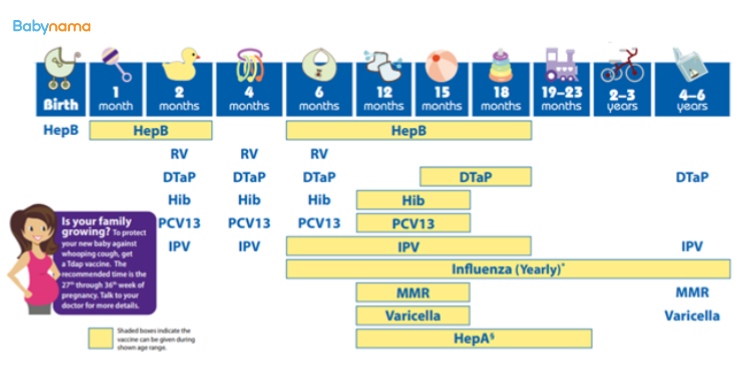
Q: What’s the vaccination schedule in India?
A: The IAP (Indian Academy of Pediatrics) recommends:
| Age | Vaccines |
|---|---|
| Birth | BCG, OPV-0, Hepatitis B-1 |
| 6 weeks | DTwP/DTaP-1, IPV-1, Hib-1, HepB-2, Rotavirus-1, PCV-1 |
| 10 weeks | DTwP/DTaP-2, IPV-2, Hib-2, Rotavirus-2, PCV-2 |
| 14 weeks | DTwP/DTaP-3, IPV-3, Hib-3, HepB-3, Rotavirus-3, PCV-3 |
| 6 months | Influenza (annual) |
| 9 months | MMR-1 |
| 9-12 months | Typhoid conjugate |
| 12 months | Hepatitis A-1 |
| 15 months | MMR-2, Varicella-1, PCV booster |
| 16-18 months | DTwP/DTaP booster, IPV booster, Hib booster |
| 18 months | Hepatitis A-2 |
| 4-6 years | DTwP/DTaP 2nd booster, MMR-3, Varicella-2 |
Based on the IAP ACVIP 2024–25 schedule. Birth doses (BCG, OPV-0, Hepatitis B-1) are usually given in hospital before discharge. Typhoid conjugate (TCV) is licensed from 6 months — many give it with MMR at 9 months. Exact vaccines and timing should be confirmed with your pediatrician.
Q: My baby missed a vaccine. Do we need to restart?
A: NO! You don’t need to start over.
- Simply continue from where you left off
- Catch-up schedules exist for missed vaccines
- Consult your pediatrician for the best plan
- The sooner you catch up, the better
Q: Can I delay or spread out vaccines?
A: Sticking to the schedule is best where you can.
Why timely vaccination matters:
- Babies are most vulnerable to many diseases in the first year
- Delaying leaves a baby unprotected for longer
- There is no evidence that spreading out the schedule is safer
- Extra visits mean more pokes and stress for baby The schedule is designed around when babies need protection most. If you have fallen behind for any reason — illness, a NICU stay, or access — that is okay; your pediatrician will set up a catch-up plan.
Q: What if baby is slightly sick on vaccination day?
A: Usually you can still vaccinate!
| Condition | Can Vaccinate? |
|---|---|
| Mild cold, runny nose | Usually YES |
| Low-grade fever | Usually YES |
| On antibiotics | Usually YES |
| Recovering from illness | Usually YES |
| Moderate-to-high fever (around 38.5°C / 101.3°F or above) | Pediatrician may WAIT |
| Clearly unwell / serious illness | Pediatrician may WAIT |
| Previous severe reaction | DISCUSS with doctor |
Minor illness or a low-grade fever is not a reason to postpone. For a moderate-to-high fever or a baby who is clearly unwell, your pediatrician may decide to defer. When in doubt, your pediatrician decides — ask them.
⚠️ In a baby under 3 months, ANY fever of 100.4°F (38°C) or higher is a medical emergency — see a doctor the same day, even at night. Do not give paracetamol and wait. This applies even after a vaccine.
Side Effect Questions
Q: What side effects can I expect?
A: Most side effects are mild and temporary:
Common (usually nothing to worry about):
- Mild fever (around 38–38.5°C)
- Soreness at injection site
- Fussiness for 1-2 days
- Mild swelling/redness at site
- Slight decrease in appetite
- Sleepiness
Call your doctor (same day) if you see:
- High fever above 40°C (104°F)
- Continuous crying for more than 3 hours
- Unusual high-pitched crying
- Severe swelling beyond the injection site
🚨 Call 112 (national emergency) or 108 (ambulance), or go straight to the nearest hospital, if you see: difficulty or noisy breathing; swelling of the face, lips or tongue; widespread hives with vomiting; pale, grey or blue skin; floppiness or unresponsiveness; or a seizure. These can be a severe allergic reaction (anaphylaxis). If an adrenaline auto-injector has been prescribed, use it first, then go. Do not wait for a clinic appointment.
Why clinics ask you to wait ~15–30 minutes after the shot: most serious allergic reactions happen within the first 15–30 minutes, so it is safest to stay where help is on hand rather than leaving immediately.
If your baby has a seizure (fit): stay calm. Lay your baby on their side, do not put anything in the mouth, and time how long it lasts. Most fits with fever are brief and stop on their own. Call 112/108 or go to the nearest hospital if it is the first-ever seizure, if it lasts more than 5 minutes, or if your baby is not breathing normally or does not come round afterwards.
Q: Can vaccines make my baby sick?
A: Vaccines cause MILD symptoms, not the actual disease.
- The “sick” feeling is your baby’s immune system learning
- This is far milder than what the actual disease would cause
- A mild fever can occur as the immune system responds, but many babies have no fever and are still fully protected — fever is not needed for the vaccine to work
- Symptoms usually settle in 1-3 days
Q: How do I manage post-vaccination fever?
A: Simple steps:
| Action | Details |
|---|---|
| Give paracetamol | Crocin/Calpol — dose by weight (see below) |
| Don’t overdress | Light, comfortable clothing |
| Keep hydrated | Breastfeed often, offer fluids if older |
| Sponge if needed | Lukewarm water, not cold |
| Monitor | Check temperature every few hours |
| Comfort | Cuddle, soothe, distract |
Paracetamol dosing: Paracetamol is dosed by your baby’s weight, not age: 15 mg/kg per dose, no more often than every 4–6 hours, maximum 4 doses (60 mg/kg) in 24 hours. Syrup strengths differ — Calpol/Crocin come as 120 mg/5 ml and 250 mg/5 ml, so always check the bottle. Do not give to a baby under 3 months without a doctor seeing them first. Confirm the exact mL with your pediatrician.
Note: Don’t give paracetamol BEFORE vaccination (may reduce effectiveness). Give it AFTER if fever develops.
Comfort Questions
Q: How can I help my baby during vaccinations?
A: Before, during, and after strategies:
Before the shot:
-
Stay calm (babies sense your anxiety)
-
Don’t skip feeds - hungry babies are crankier
-
Dress baby in easy-to-remove clothing During the shot:
-
Breastfeed during or immediately after
-
Hold baby close
-
Use swaddling for infants
-
Distract older babies with toy/song
-
Stay calm and confident After the shot:
-
Cuddle and comfort
-
Breastfeed or give bottle
-
Don’t rub the injection site
-
Use cold compress if swollen
-
Give paracetamol if fever develops
-
Praise older children
Q: Should I breastfeed before/after vaccination?
A: Yes — breastfeeding is excellent comfort:
- Can breastfeed during the shot (pain relief!)
- Breastfeed immediately after for comfort
- Breast milk provides additional immune support
- Does NOT interfere with vaccine effectiveness
Specific Vaccine Questions
Q: Is chickenpox vaccine necessary? My parents say natural chickenpox is better.
A: Vaccine is safer than natural infection!
| Natural Chickenpox | Vaccine |
|---|---|
| Can cause serious complications | Prevents complications |
| Risk of skin infections, pneumonia, brain inflammation | Usually only mild side effects; serious reactions are rare |
| Can be fatal in some children | Far lower risk than the disease itself |
| Stays in body, can cause shingles later | Reduces shingles risk |
| Spreads to vulnerable people | Protects community |
Q: Does DTwP hurt more than DTaP?
A: DTaP (acellular) generally causes:
-
Less fever
-
Less soreness
-
Less fussiness DTwP (whole cell) is:
-
Equally effective
-
More affordable
-
What government provides free Both are safe and work well!
Q: Are combination vaccines safe?
A: Yes — combination vaccines:
- Reduce number of injections
- Equally effective as separate vaccines
- Thoroughly tested for safety
- Less stress for baby
- Fewer clinic visits
Myth-Busting
Common Vaccine Myths - BUSTED
| Myth | Fact |
|---|---|
| ”Vaccines cause autism” | No link found in decades of large studies |
| ”Natural immunity is better” | Natural diseases can kill before immunity develops |
| ”Too many vaccines overload immune system” | Babies handle thousands of antigens daily |
| ”Vaccines contain dangerous toxins” | Ingredients are present in tiny amounts and are well studied |
| ”Diseases are eliminated, no need for vaccines” | Diseases return when vaccination rates drop |
| ”My baby is healthy, doesn’t need vaccines” | Vaccines keep healthy babies healthy |
Frequently Asked Questions
Q: Government clinic or private - which is better?
A: Both provide essential protection!
| Government | Private |
|---|---|
| Free | Paid |
| Basic vaccines | Additional optional vaccines |
| May be more crowded | Usually shorter wait |
| DTwP (whole cell) | Often DTaP (acellular) |
| Equally effective | More combination options |
Q: Can I give vaccines if baby was premature?
A: Yes — premature babies need protection just as much, often more. Follow chronological age (from the birth date), not corrected age, unless your doctor advises otherwise. One exception: for very low birth weight babies (under about 2 kg) the birth-dose hepatitis B may be timed differently, and very preterm or NICU babies may be monitored for apnoea (pauses in breathing) around their first shots. Your neonatologist or pediatrician will guide you.
Q: Should I wake a sleeping baby for vaccination appointment?
A: Yes, keep the appointment. Sleeping babies can be vaccinated. You can let them sleep if they fall asleep afterward.
Key Takeaways
- Vaccines are very safe - Extensively tested, continuously monitored; serious reactions are rare
- No link to autism - Decades of large studies have found none
- Follow the schedule where you can - Timely vaccination gives the earliest protection; behind-schedule is fixable with a catch-up plan
- Most side effects are mild - Fever and soreness usually settle in a few days; know the danger signs
- Missed vaccines can be caught up - No need to restart
- Breastfeed for comfort - During and after shots
- Know when to act fast - Difficulty breathing, swelling, floppiness or a seizure: call 112/108 or go to the nearest hospital
This article was reviewed by pediatricians at Babynama. Last updated: February 2026. Schedule based on the IAP ACVIP 2024–25 immunization schedule.
This article is general information for Indian parents, not a substitute for examination by your pediatrician. In an emergency, call 112 or 108.
Need personalized guidance? Book a consultation with our pediatricians or explore our Care Plans for 24/7 expert support!
Related Tools